Crucifixion as torture
-
David Tombs, Sithembiso Zwane and Charlene van der Walt, ‘Male Violence Against Men: A Contextual Bible Study on the Crucifixion of Jesus’, in Jione Havea (ed) Haunting Questions of Liberation Theology (2025), Otago archive.
Rocío Figueroa and David Tombs, ‘Vendo Sua Inocência, Eu Vejo Minha Inocência’, Estudos Teológicos (2024). Open access (Brazilian Portuguese); Open access (English). Otago archive (English original 2021).
David Tombs, ‘Things Too Indecent to be Recorded: The Soldiers Mocking the Death of Herod Agrippa’, in Juliana Claassens. Rhiannon Graybill and Christl Maier (eds), Narrating Rape: Shifting Perspectives in Biblical Literature and Popular Culture (2024). Otago archive.
David Tombs, 'Art depicts Jesus in a loincloth on the cross – the brutal truth is he would have been naked’, The Conversation (28 March 2024). Open access.
David Tombs, ‘Alone and Naked: Reading the Torture of Jesus alongside the Torture of Miriam Leitão’, International Journal of Public Theology (2023). Open access.
David Tombs, The Crucifixion of Jesus: Torture, Sexual Abuse, and the Scandal of the Cross (Routledge, 2023). Open access.
David Tombs, 'The Pink Crosses of Ciudad Juárez' in Rebekah Pryor and Stephen Bevans (eds) Feminist Theologies: Interstices and Fractures (2023). Otago archive.
David Tombs, ‘Reading Crucifixion Narratives as Texts of Terror’ in Monica Melanchthon and Robyn Whitaker (eds.) Terror in the Bible: Rhetoric, Gender, and Violence (SBL 2021), Open access.
Jayme R. Reaves, David Tombs and Rocío Figueroa (eds), When Did We See You Naked?’: Jesus as a Victim of Sexual Abuse (2021). Open access.
Rocío Figueroa and David Tombs, ‘Seeing His Innocence, I See My Innocence’, (2021). Open access.
Rocío Figueroa and David Tombs, ‘Viendo su Inocencia veo mi Inocencia’, (2021). Otago archive.
David Tombs, ‘Hidden in Plain Sight: Seeing the Stripping of Jesus as Sexual Violence’, Journal for Interdisciplinary Biblical Studies (2020). Open access.
David Tombs, ‘Unspeakable Things: Drawing upon the Nanjing Massacre to Read Crucifixion as an Assault on Human Dignity’ in Zhibin Xie et al. (2020). More info.
‘Recognising Jesus as a Victim of Sexual Abuse. Responses from Sodalicio Survivors in Peru’, (2020). Open access.
Jayme Reaves and David Tombs, '#Me Too: Naming Jesus as a Victim of Sexual Abuse', Review and Expositor (2020). Open access.
Jayme R. Reaves and David Tombs, ‘#MeToo Jesus: Naming Jesus as a Victim of Sexual Abuse’, International Journal of Public Theology (2019). Open access.
David Tombs, Crucifixion and Sexual Abuse (2019). Otago archive English, Spanish, French, German.
David Tombs, 'Crucificação e abuso sexual' (2019). Open access(Brazilian Portuguese).
Edwards and Tombs, ‘#HimToo – why Jesus should be recognised as a victim of sexual violence’, The Conversation (2018). Open access.
David Tombs, ‘Prisoner Abuse: From Abu Ghraib to The Passion of The Christ’ (2009). Otago archive.
David Tombs, ‘Crucifixion, State Terror, and Sexual Abuse’, (Union Seminary Quarterly Review (1999). Open access.
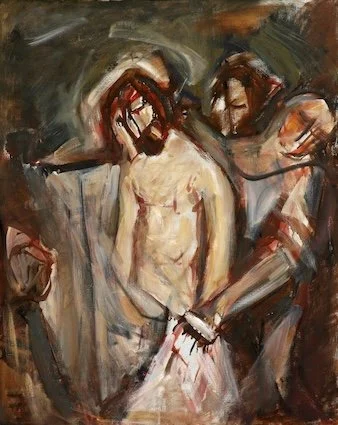
Three principles shape my research on crucifixion as torture…
First, repressive states use torture to intimidate as well as to punish. Torture sends a terrifying threat to a wider public audience as well as punishing the individual..
Second, different forms of sexualised violence are an overwhelmingly common practice in torture. Torture often includes punitive stripping and forced nudity to create fear and vulnerability. Stripping and nudity during torture serve as forms of sexualised violence in their own right, and they are frequently a prelude to other forms of sexualised violence such as genital beating, penetrative sexual assault, and other sexualised violence. These greatly reinforce the threat and fear associated with torture.
Third, whilst the prevalence of sexualised violence in torture practices is quite well-known it is often associated with a stigma that creates silence and silencing. As a result, sexualised violence is often omitted from records, under-estimated in analysis, and marginalised from discussion. This erasure makes the sexualised elements of torture easy to miss and hard to investigate. To piece the evidence together when investigating Jesus’ crucifixion there needs to be attention to text, context. and possible sub-text.
Image attribution: ‘Tenth Station of the Cross, Jesus is Stripped of His Garments’, Church of Holy Cross, Sisak, Croatia © Zatletic Dreamstime.com. Used under licence.